
Have you ever watched one of those TV programmes where wealthy people swap lives with someone on a much tighter budget and have to survive on what their swap partner actually earns? I have. And instead of just watching and feeling vaguely inspired, I decided to actually ‘semi test’ it myself. No I haven’t swapped my house with anyone nor my budget. I simply set up myself a challenge to live on a small budget and live only on CASH so I see where the money is going.
I set myself a challenge: withdraw £300 in cash and live on it for an entire month. No card. No contactless. No sneaky top-ups from the savings account. Just notes and coins in my purse — and whatever was left when the month ended.
Spoiler: I made it. And honestly? It changed how I think about money in ways I didn’t expect.
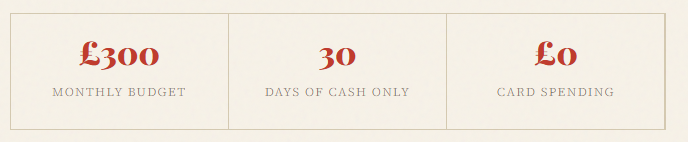
Table of Contents
Why I Decided to Try the Cash-Only Challenge
Most of us have completely lost touch with what money actually feels like. When you tap your card, nothing registers. It’s just a number on a screen that you’ll deal with later — usually when the bank statement arrives and the damage is already done.
I wanted to feel every pound leaving my hand. I wanted spending to mean something again.
My normal discretionary spend sits somewhere between £600-£700 a month (this is minus bills and covers grocery shop, transportation, spend when I am in the office and any extras like takeaways or occasional small treats as I am not going out much etc.). Not extravagant, but definitely comfortable. Cutting it by 50% to £300 was going to require a genuine rethink — not just trimming the edges, but actually changing how I moved through the month.
The Coffee Wake-Up Call
Week one taught me something I already knew but hadn’t quite faced: my coffee habit was quietly expensive.
A flat white here, a latte before a meeting there. At £3.80 to £4.50 a go, two or three coffees a week from coffee shops was easily costing me £30 a month. On a £300 budget, that’s a 10% of my budget gone before I’d even thought about food, so it had to stop!
I had to forget about my beloved Rosslyn or Kiss the Hipo near my office…I simply stopped buying coffee out and started bringing my own brewed coffee whenever I went to the office. I made it at home, properly, before I left. And you know what — I actually enjoyed it more as I buy quality beans. There’s something about making your own coffee that feels more like a ritual and less like a transaction. Also I enjoy the beans I get from Redber coffee, so the quality hasn’t worsened. I am even able to treat myself to a bit more expensive, yet organic and lab tested coffee from Exhale that seems to have as much polyphenols as a handful of blueberries. That change makes me happiest as if we want to go for top quality we pay more but still control what we get like in the case of Exhale coffee. Other times I go to for Mindful coffee – ok, ok you surely get that coffee is important to me…I am not prioterising control (picking quality beans)over frivolous spend when it comes to coffee 🙂 I GAINED not lost in my opinion….
That one swap alone gave me breathing room for the rest of the month.
When you physically hand over a £20 note and watch the change come back, you feel the cost of things. That feeling is the whole point.
Packed Lunches: The Habit I Lost when Life got Busy
Office days had always been expensive by default. A meal deal here, a hot lunch there, a mid-afternoon snack etc. None of it felt significant in the moment, but together it was easily £8–12 a day — without even thinking about it. Again the inability to know 100% what is inside was also disturbing!
On the cash challenge, that wasn’t money I had. So I packed lunch every single office day. Batch-cooked salads(this is my absolute fav as tastes better the next day, leftover pasta, homemade wraps. It sounds boring written down, but it genuinely wasn’t. My lunches were often better than anything I’d have bought, and definitely healthier, no toxic seeds oils not additives or preservatives. 100% control again! Another WIN!
This single switch saved me somewhere around £100 over the month. Which, on a £300 budget, is enormous.
Getting to Work for Almost Nothing
Transport was the next puzzle to solve. Luckily I had two options: bicycle or motorcycle.
Last September I bought an electric bike as even though it is 18km to get to my office and another 18 to get back home, these 36kms make me happy like nothing else. When the sun is out and you cycle and most of it is on a safe cycle paths something beautiul happens with your mind. It gets quiet and happier! So yes, it was FREE Fitness and mental health aid, when I most needed it.
The boke I got is rther basic and was cheap. When you live in London you know you need to think about the threat of theft so its better to go that way and get something functional yet cheap….so did I with my isinwheel bike which cost me round £500. The bike got already paid back as if we account 8-12 visits per month in the office it roughly takes 3-5 months for it to be paid back – assuming I was taking the train for ca £11 each time…
On good days I cycled. The bike costs nothing to run, it’s already paid for, and as I already said there is something genuinely wonderful about arriving at work having already moved your body and cleared your head. No podcast needed. No commute rage. Just fresh air and a slightly smug sense of achievement.
On less beautiful days I took the motorcycle. Including the tunnel fee and petrol, the return journey cost me around £4. Compare that to the train fee which for me is £11.80 a day — and the math is obvious. Using the motorcycle on my non-cycling commute days saved me ca £50 across the month.
Shopping at Lidl — Properly This Time
I’d always known Lidl was cheaper. I’d done the occasional shop there and felt quietly virtuous about it. But the cash challenge forced me to make it my default, and the difference was stark.
The same weekly shop that cost me £55–65 in a larger supermarket dropped to £35–40 at Lidl. The produce is good, the own-brand staples are perfectly decent, and nobody is nudging you into buying things you didn’t plan for with loyalty points and special offers placed at eye level. In fact they sometimes give you discounts on what you previously bought or fereebies also based on your shopping patters.
On the occasions I did end up in other supermarkets, I became a yellow label hunter. Reduced-to-clear items — often 50 to 75% off because they’re approaching their use-by date — are one of the most underrated tools available to anyone who actually wants to save money on food. I’d pick up whatever was reduced, freeze what I could, and plan meals around it. It felt resourceful rather than restrictive. Genuinely satisfying, actually.
The Hardest Part: Social Life
I’ll be honest about this because nobody else seems to be: the social side of the cash challenge was genuinely difficult.
When friends suggested dinner out, or it was someone’s round at the pub, the cash challenge created an uncomfortable friction I hadn’t anticipated.
I handled it differently depending on the situation. Sometimes I suggested alternatives — a walk, a coffee at mine, cooking something together at home. Sometimes I went along and ordered the cheapest thing on the menu and nursed one drink or a tap water. A couple of times I just explained what I was doing, which actually opened up a more interesting conversation than the evening itself might have done. People are usually more understanding than you expect.
The Library — A Resource I’d Completely Forgotten About
I rediscovered my local library during ( I actually signed in 2022) but I’m a little embarrassed it took a cash experiment to get me back through the door as my frequency of visits was inconsidtent- more down lately….
Free books. Free digital borrowing. Free access to newspapers and magazines….
In a month where I was watching every pound, the library felt almost radical. All of that value, sitting there, publicly funded, waiting to be used — and most of us walk straight past it on our way to buy something instead. Don’t be like me. Use your library! They have many popular books, I was suprised how up to date my local library actyally is.
What Changed After the 30 Days
I didn’t stay on a £300 budget permanently — that was never the plan. But I kept more habits than I expected to.
The packed lunches stuck. I still bring a thermos most days. Lidl is my main shop now rather than an occasional detour. And I’ve kept up the yellow label habit — not because I have to, but because it gives me a small, quiet win every single time.
The biggest shift is harder to explain, though. It’s the pause. Before I spend money on something now, there’s a half-second where I actually think about whether I want it. That sounds like an obvious thing to do with money, but contactless payments are specifically designed to eliminate that pause. Cash brought it back.
And it turns out a half-second of friction changes quite a lot.
I didn’t become a different person. I just started making decisions rather than letting my card make them for me.
How I stretched £300 across 30 days
- Switched all coffee to homemade — saved ~£40
- Packed lunches every office day — saved ~£100
- Cycled or took the motorcycle to work — saved ~£50-£60
- Shopped at Lidl as the default — saved ~£30 vs usual supermarket
- Yellow label hunting on reduced items — saved ~£20
- Library instead of bookshops or streaming — saved ~£10
Should You Try It?
I’m not going to tell you that £300 covers everything — it clearly doesn’t, and my fixed bills were covered separately before I started. But the principle scales. Pick a discretionary spending limit that feels genuinely tight. Withdraw it in cash. See how long it lasts — and more importantly, pay attention to what you learn about yourself when it starts running low.
You’ll find your own version of my coffee habit. You’ll discover your own packed-lunch equivalent. And I’d bet on you finding at least one thing you were spending money on purely out of habit — not because you actually wanted or really needed it.
That moment of clarity is worth more than the £300 I saved.
Have you ever tried a cash-only challenge — or thought about it? I’d love to hear in the comments below!
Disclaimer
**This article reflects my own personal experience of the cash-only challenge. Individual budgets, circumstances, and outcomes will vary. All savings figures are approximate and based on my own spending patterns before and during the challenge.